11 · Exotic Options · Volatility Skew

Digital
Options.

Cash-or-nothing and asset-or-nothing digitals, with and without barriers, priced on the CAC40 under the calibrated Heston model. A digital is the slope of the call price in the strike, so its price is set by the volatility skew rather than by the volatility level: an at-the-money one-year digital call is worth 559 for 1,000 paid, against 466 in Black-Scholes at its own implied volatility. That is a 20% gap that a flat-volatility model cannot see.

Context Personal study — October 2026
Underlying CAC40, 12/02/2025 · Heston calibrated on 142 options (0.42 vol pts)
Products Cash and asset digitals · digital knock-in / knock-out barriers
Method Strike derivative of Lewis prices · Monte Carlo · Brownian bridge · Greeks

All or nothing.

A digital (or binary) option pays a fixed amount if the underlying ends above a strike, and nothing otherwise. It is the simplest bet on the direction of the market, and the building block of many structured products: every autocall coupon and every call event of an autocall is a digital.

Its simplicity is deceptive. The payoff jumps at the strike, so the digital is the derivative of the call price with respect to the strike. Its price therefore depends on the slope of the volatility smile, its Greeks change sign near the strike, and its hedge becomes unstable close to maturity.

This project prices the four European digitals and the eight digital barrier options under the Heston model calibrated in the Heston project, with the Monte Carlo engine of the barrier option pricer, and measures the effect of the skew.

Cash-or-nothing and asset-or-nothing.

Payoffs at maturity
\[ \text{cash call}=c\,\mathbf 1_{\{S_T>K\}}, \qquad \text{asset call}=S_T\,\mathbf 1_{\{S_T>K\}}, \qquad \text{puts: } \mathbf 1_{\{S_T\lt K\}} \]
Payoffs of the cash and asset digital calls and puts as a function of the terminal spot
Payoffs of the four digitals (\(K=100\), cash 10).

A vanilla call is an asset-or-nothing call minus \(K\) cash-or-nothing calls: \((S_T-K)^+=S_T\mathbf 1_{\{S_T>K\}}-K\,\mathbf 1_{\{S_T>K\}}\). Since a call and a put with the same strike always pay exactly one of the two indicators, digitals have their own parity relations:

Digital parities
\[ \text{cash call}+\text{cash put}=c\,D(T), \qquad \text{asset call}+\text{asset put}=D(T)\,F(T) \]

A digital barrier option adds a knock-in or knock-out barrier to a digital (for example a down-and-out cash digital call, CDO), with the same eight combinations as the barrier options and the in / out parity \(\text{knock-in}+\text{knock-out}=\text{digital}\). Digitals are European only: an "American" cash digital, paid as soon as the strike is reached, is a one-touch option, which is a barrier product.

The slope of the call price.

Black-Scholes. With \(D(T)\) the discount factor and \(F(T)\) the forward, the digitals have closed forms (BlackScholes.bs_price_digital):

Black digitals
\[ \text{cash}=c\,D(T)\,N(\phi d_2), \qquad \text{asset}=D(T)\,F(T)\,N(\phi d_1), \qquad d_{1,2}=\frac{\ln(F/K)\pm\frac12\sigma^2T}{\sigma\sqrt T} \]

with \(\phi=+1\) for a call and \(-1\) for a put. \(N(d_2)\) is the risk-neutral probability of finishing in the money.

Any model. Differentiating the call price \(C(K)=D\,\mathbb E[(S_T-K)^+]\) with respect to the strike gives \(\partial C/\partial K=-D\,\mathbb Q(S_T>K)\), so the digitals are model-free functions of the vanilla prices:

Digitals from vanillas
\[ \text{cash call}=-c\,\frac{\partial C}{\partial K}, \qquad \text{cash put}=c\,\frac{\partial P}{\partial K}, \qquad \text{asset call}=C-K\frac{\partial C}{\partial K} \]

Under Heston, the vanilla prices come from the Lewis formula and the strike derivative is a central difference with a step of 0.1% of the strike (exact_european_price). This semi-analytical price is the reference for the European digitals and the control variate of the digital barriers, which are priced by Monte Carlo.

The skew effect. With a smile, the call price is the Black price at a strike-dependent volatility, \(C(K)=C_{\mathrm{BS}}(K,\sigma(K))\). The chain rule gives

Digital with a smile
\[ \text{cash call}= \underbrace{c\,D\,N(d_2)}_{\text{Black at }\sigma(K)} \;\underbrace{-\;c\,\mathcal V_{\mathrm{BS}}\,\frac{\partial\sigma}{\partial K}}_{\text{skew effect}} \]

With the negative equity skew (\(\partial\sigma/\partial K\lt0\)), a digital call is worth more than its Black price at its own implied volatility, and a digital put less. The correction is proportional to the Vega and to the slope of the smile, not to its level.

Three prices for each digital.

In a flat Black-Scholes market (\(S_0=100\), \(r=3\%\), \(q=1\%\), \(\sigma=20\%\), \(T=1\), cash 10), simulated as a Heston model without vol-of-vol, each digital is priced three ways: the Black closed form, the strike derivative of the model's vanilla prices, and Monte Carlo without control variate (100,000 antithetic paths).

Option Black From vanillas Monte Carlo Std error Error / std error
Cash call K=906.80126.80136.80020.0106−0.10
Cash put K=902.90322.90322.90430.01060.10
Asset call K=9075.87075.87075.8730.0820.04
Asset put K=9023.13523.13523.1360.0860.01
Cash call K=1004.85224.85234.85230.00020.58
Cash put K=1004.85224.85224.85210.0002−0.58
Asset call K=10057.35057.34957.3660.0330.48
Asset put K=10041.65541.65641.6430.021−0.57
Cash call K=1103.07483.07483.07520.01050.04
Cash put K=1106.62976.62966.62930.0105−0.04
Asset call K=11038.71738.71738.7330.1340.12
Asset put K=11060.28860.28860.2750.126−0.10

Flat market, cash 10. The strike derivative of the vanilla prices matches the closed form within \(5\times10^{-4}\).

All Monte Carlo prices are within 0.6 standard errors. The parities hold: at \(K=100\), the cash call and put are both worth 4.8522, which add up to \(10\,e^{-0.03}=9.7045\), and the asset call and put add up to \(D\,F=100\,e^{-0.01}=99.005\).

The standard error of the at-the-money cash digitals is 60 times smaller than at the other strikes (0.0002 against 0.0106). This comes from the antithetic variates: near the money, a path and its mirror image almost always end on opposite sides of the strike, so their average payoff is almost always half the cash, and its variance collapses.

What the skew is worth on the CAC40.

One-year cash digitals paying 1,000 on the CAC40 (spot 8042, one-year forward 8025), priced three ways: Heston from the Lewis vanilla prices, Monte Carlo under Heston (50,000 paths, no control variate), and Black-Scholes with the market implied volatility at the strike.

Option Heston (Lewis) Monte Carlo Std error Black at \(\sigma(K)\) Skew effect
Call K=7200764.62765.941.56687.26+77.4
Call K=7600677.24676.731.63584.15+93.1
Call K=8000559.03557.421.63466.37+92.7
Call K=8400411.87410.561.62340.38+71.5
Call K=8800259.99257.221.61225.96+34.0
Put K=7200212.35211.031.56289.71−77.4
Put K=8000417.95419.551.63510.60−92.7
Put K=8800716.98719.751.61751.01−34.0

One-year cash digitals, cash 1,000. Skew effect: Heston minus Black at the implied volatility of the strike.

The Monte Carlo prices agree with the semi-analytical ones within 1.8 standard errors. The skew effect is large: +93 on a one-year at-the-money digital call, which is worth 559 instead of 466. A trader pricing digitals with the implied volatility of the strike would sell the digital call 17% below its value and the digital put 22% above it. Call and put effects are exactly opposite, since cash call plus cash put is the discounted cash in both models.

The first-order formula of section 03, evaluated with the market one-year smile, explains most of the gap: \(-c\,\mathcal V\,\partial\sigma/\partial K\) gives +63, +90 and +27 at 7200, 8000 and 8800, against +77, +93 and +34 measured. The remainder comes from the difference between the Heston smile and the market smile, and from the linear interpolation of the market volatilities used for the slope.

The effect is largest between 7600 and 8000, where the one-year skew is steepest (−0.29 vol point per 100 index points at the money) and the Vega is highest, and falls to +34 at 8800, where the smile flattens (−0.10 per 100 points).

Practical consequence. Desks price and hedge a digital as a tight call spread, \(\big(C(K-\varepsilon)-C(K+\varepsilon)\big)/2\varepsilon\), on the market smile. This captures the skew effect automatically and turns the hedge into vanillas, while overhedging slightly to stay on the safe side of the jump.

Digital barrier options.

One-year cash digitals (cash 1,000, \(K=8000\)) with a down barrier at 7200 or an up barrier at 8800, priced by Monte Carlo with continuous monitoring (Brownian bridge) and with daily monitoring. The European digital, whose price is known, is the control variate: it is much more correlated with a digital barrier than the vanilla.

Option Barrier Price Std error Daily monitoring Discrete bias
CDI (call, down-and-in)7200113.371.2497.74−13.8%
CDO (call, down-and-out)7200445.651.24461.28+3.5%
CUI (call, up-and-in)8800377.381.45365.20−3.2%
CUO (call, up-and-out)8800181.641.45193.82+6.7%
PDI (put, down-and-in)7200350.941.01340.65−2.9%
PDO (put, down-and-out)720067.011.0177.29+15.3%
PUI (put, up-and-in)880068.951.0060.05−12.9%
PUO (put, up-and-out)8800348.991.00357.90+2.6%

Cash digital barriers, cash 1,000, \(K=8000\), \(T=1\). Discrete bias: daily monitoring relative to continuous.

For each pair, knock-in plus knock-out equals the European digital (559.03 for the calls, 417.95 for the puts) to machine precision, by construction of the survival weights and the control variate. Daily monitoring misses the crossings between two dates, so it overprices every knock-out and underprices every knock-in. The bias is largest for the products whose value comes from paths that stay close to the barrier: PDO +15%, CDI −14%, PUI −13%.

The CUO is the most extreme product of the set: it pays 1,000 if the index ends between 8000 and 8800 without ever touching 8800. It is worth 182, a third of the plain digital, and its value is concentrated in a narrow corridor.

Greeks that change sign.

Greeks are computed by bump and revalue with common random numbers (spot ±1%, volatility ±1 point, rates ±10 bp, one day for Theta). With the control variate, a European digital is priced exactly, so its Greeks are those of the semi-analytical price. Without it, the Monte Carlo Greeks show how hard the payoff jump makes them to estimate:

Greek Semi-analytical Monte Carlo MC std error
Price559.03557.421.63
Delta0.33430.33650.0063
Gamma (×10⁴)−2.74−3.201.59
Vega−6.09−6.020.38
Vanna−0.0240−0.02520.0031
Volga0.280.200.86
Rho21.2921.291.62
Theta−0.022−0.0460.083

One-year ATM cash digital call, cash 1,000. Greeks of the semi-analytical price, and Monte Carlo without control variate (14.5 s).

Delta, Vega, Vanna and Rho are estimated within one standard error. The Monte Carlo Gamma is only about two standard errors away from zero, and Volga and Theta are indistinguishable from zero in the simulation: the second derivatives of a step function are dominated by the few paths that end near the strike.

Option Price Delta Gamma (×10⁴) Vega Volga Rho Theta
Digital call559.030.334−2.74−6.090.2821.29−0.022
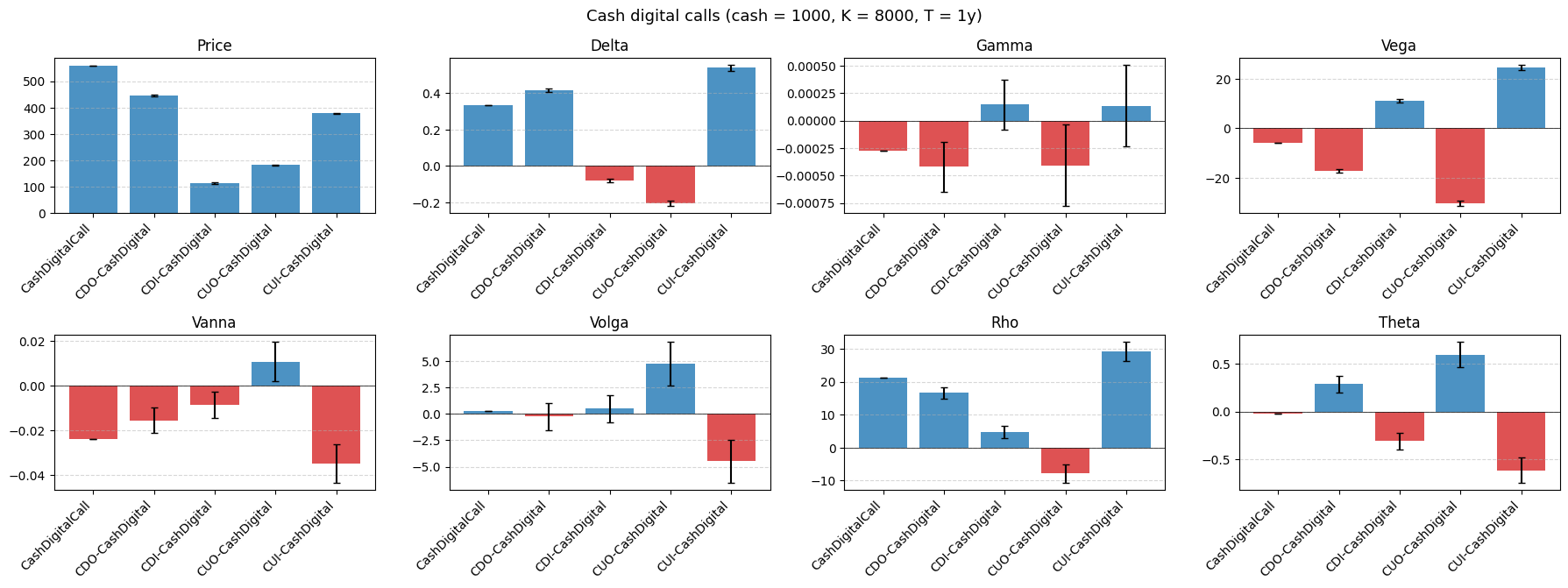
CDO, H=7200445.650.415−4.19−17.22−0.2416.590.287
CDI, H=7200113.37−0.0811.4511.130.524.71−0.309
CUO, H=8800181.64−0.205−4.08−30.504.77−7.870.597
CUI, H=8800377.380.5391.3424.41−4.5029.16−0.619

Cash digital calls with and without barrier, cash 1,000, \(K=8000\), \(T=1\), at the current spot (47 s).

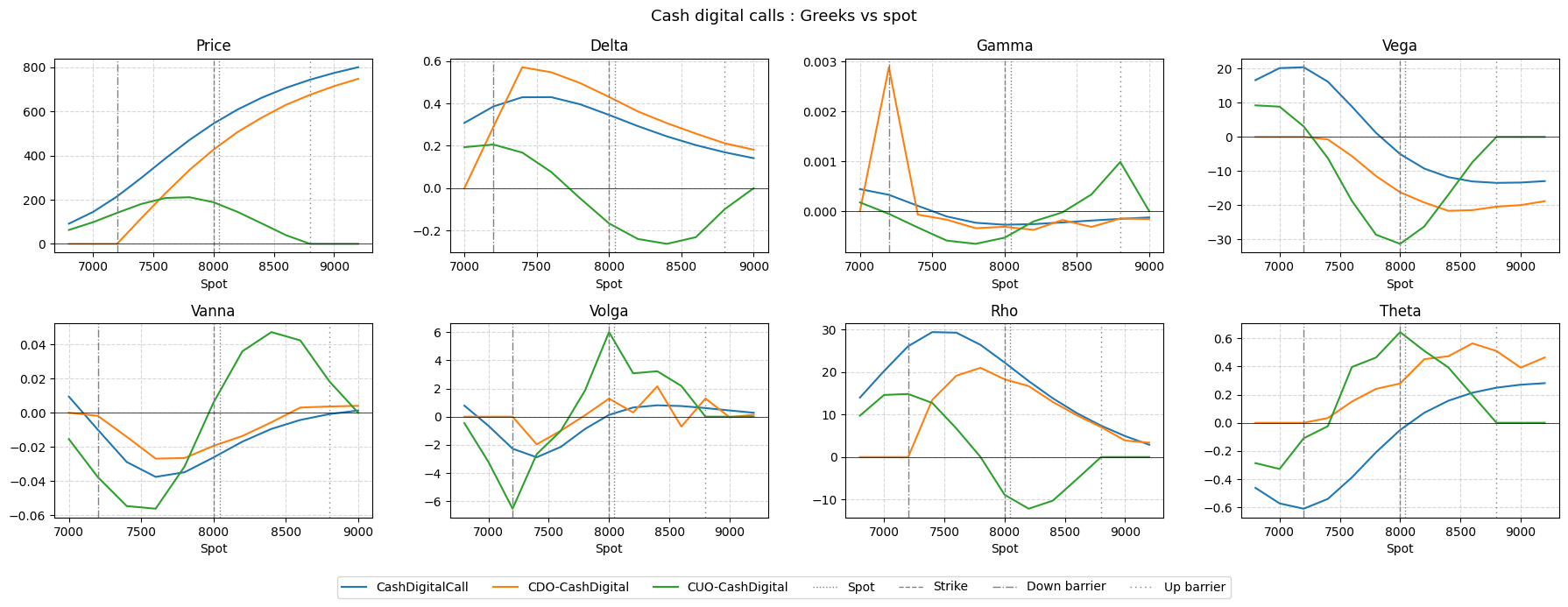
Vega The at-the-money digital call has a negative Vega (−6.1): the forward (8025) is slightly above the strike, so more volatility makes ending below 8000 more likely. Out of the money, its Vega is positive (about +20 around 7200): the sign flips with the moneyness.
Gamma Positive when the digital call is well out of the money (below about 7500), negative near and above the strike: it is long convexity when it needs the market to move, short when it only needs it to stay.
CUO The up-and-out digital is the most volatility-sensitive product (Vega −30.5 per vol point, 17% of its price), with a negative Delta: a higher spot brings it closer to the barrier that kills it.
Theta Positive for the knock-outs (+0.29 and +0.60 a day): each day without touching the barrier makes the payment more likely.
Bar charts of the price and Greeks of the digital call and four digital barrier calls
Price and Greeks of the cash digital calls, with 95% Monte Carlo confidence intervals.
Price and Greeks of the digital call, the down-and-out and the up-and-out digital calls as a function of the spot
Price and Greeks against the spot (6800 to 9200, 30,000 paths, 63 s). Vertical lines: spot, strike, down barrier 7200, up barrier 8800.

The profiles show the hedging problem. The Delta of the digital call peaks around 7400–7600, below the strike, where the probability of finishing in the money changes fastest. The CDO's Gamma spikes at its barrier (0.0029 at 7200), and the CUO's Delta goes from +0.2 to −0.26 between 7000 and 8400: a hedger must buy the index on the way up and sell it as the barrier approaches. As maturity nears, these peaks sharpen further, which is why digitals are hedged with call spreads rather than with the underlying.

Two classes on top of the existing engine.

DigitalOption Subclass of VanillaOption in products.py: cash or asset payoff, exact_european_price from the model's vanilla prices, and its own payoff as control variate.
DigitalBarrierOption Inherits the payoff from DigitalOption and the barrier (direction, knock, monitoring) from BarrierOption, so the Monte Carlo engine prices it with no new code.
Black-Scholes bs_price_digital: cash and asset closed forms on the forward, used for the validation and the skew comparison.
Engine MonteCarloPricer and Greeks from the barrier option project, shared with the Athena and Phoenix autocalls.

What remains approximate.

01

Finite-difference strike derivative

The semi-analytical digital is a central difference of Lewis prices with a 0.1% step. It matches the Black closed form within \(5\times10^{-4}\) in a flat market, but the derivative could be taken analytically under the integral sign.

Numerics
02

Noisy second-order Greeks

Gamma, Volga and Theta of digitals are hard to estimate by bump and revalue on a step payoff; pathwise or likelihood-ratio estimators, or a smoothed payoff, would reduce the noise.

Greeks
03

Model smile

Digital prices depend on the slope of the smile, and the Heston smile differs from the market by up to 1.7 vol points at long maturities. A digital priced off the market surface (call spread on SVI, for instance) would be closer to market practice.

Model risk
04

Scope

European digitals and single barriers only: no one-touch, no-touch or double no-touch options, and no rebates.

Products

A bet on the slope of the smile.

Accuracy Twelve flat-market digitals within 0.6 standard errors of the closed form; CAC40 Monte Carlo prices within 1.8 standard errors of the semi-analytical Heston prices.
Skew +93 on a 1,000 at-the-money digital call: 559 under Heston against 466 in Black-Scholes at the strike's own volatility.
Barriers Daily monitoring misprices digital barriers by up to 15%; the Brownian bridge removes the bias.
Risk Vega and Gamma change sign with moneyness; the up-and-out digital carries a Vega of 17% of its price per vol point.
A vanilla option is priced by the level of the volatility; a digital, by its slope. Any model used for digitals, and for the autocalls built from them, must therefore reproduce the skew, not just the at-the-money volatility.