12 · Structured Products · Monte Carlo

Athena autocall
on the CAC40.

A pricer for the Athena, the autocallable note whose coupon is paid only when it is called, on the CAC40 under the calibrated Heston model. One parametrisation covers every usual feature: observation frequency, snowball or fixed coupon, step-down, non-call period, European or American protection, airbag, buffer, capital guarantee, range accrual, duo call and look back. The base 4-year quarterly note is worth a fair coupon of 10.54% a year; one feature alone moves it from 4.83% to 23.94%.

Context Personal study — November 2026
Underlying CAC40, 12/02/2025 · Heston calibrated on 142 options (0.42 vol pts)
Method Monte Carlo, 50,000 antithetic paths · Brownian bridge · put control variate
Outputs Fair coupon, scenario statistics, market sensitivities, Greeks and hedge

A coupon paid for selling a put.

An autocallable note pays a coupon well above the risk-free rate and is redeemed early ("called") as soon as the index is back above a reference level on an observation date. The coupon is financed by a down-and-in put sold by the investor: if the note is never called and the index ends below a protection barrier, the investor bears the full loss.

The Athena pays its coupon only with the redemption, usually accumulated over time (snowball). Its sister product, which pays a conditional coupon at every observation date, is studied in the Phoenix project; both use the Heston model calibrated in the Heston project and the Monte Carlo engine of the barrier option pricer.
One class, every variant.

A note of nominal \(N\) has an initial fixing \(S_{\mathrm{ref}}\) and observation dates \(t_1\lt\dots\lt t_n=T\). With \(P_k=S_{t_k}/S_{\mathrm{ref}}\), the note is called at the first callable date where \(P_k\ge B^{\mathrm{call}}_k\), and then pays

Redemption at the call date
\[ N\big(1+c_k\big), \qquad c_k=\begin{cases} c\,t_k & \text{snowball},\\ c\,(t_k-t_{k-1}) & \text{fixed coupon.}\end{cases} \]

If it is never called, it pays at maturity, with a put strike \(K_{\mathrm{put}}\), a floor \(\phi\) and a buffer \(b\):

Redemption at maturity
\[ R_T=N\Big[(1-\mathbf 1_{\mathrm{KI}})+\mathbf 1_{\mathrm{KI}}\max\!\Big(\phi,\ \min\big(1,\ P_T/K_{\mathrm{put}}+b\big)\Big)\Big] \]

The knock-in \(\mathbf 1_{\mathrm{KI}}\) is \(P_T\lt B^{\mathrm{prot}}\) for a European protection, or a touch of \(B^{\mathrm{prot}}S_{\mathrm{ref}}\) at any time (continuously or on daily closes) for an American one. Every feature is one parameter of the class Athena:

Airbag \(K_{\mathrm{put}}=B^{\mathrm{prot}}\): no loss jump at the barrier.
Buffer \(b\gt0\), \(B^{\mathrm{prot}}=1-b\): the investor only loses below \(1-b\), one for one.
Guarantee \(\phi\gt0\): the redemption never falls below \(\phi N\).
Range accrual The coupon only accrues on the dates where \(L\le S_t/S_{\mathrm{ref}}\le U\).
Duo A second, lower call level where the note is called with a fraction \(\alpha\) of the coupon.
Look back \(S_{\mathrm{ref}}\) is the minimum (or average) of the index over a first period.
Calendar Observation frequency, step-down of the autocall barrier, non-call period.

A zero-coupon, a coupon strip and a short put.

With \(E_i\) the event that the note was not called before \(t_i\) and \(X_i\) the performance, the price of the Athena is affine in the coupon: the coupon changes the amount paid, never the call date. On a nominal of 1,

Decomposition
\[ P_0=\underbrace{\mathbb E^{\mathbb Q}\big[D(\tau)\big]}_{\text{notional}} +c\underbrace{\sum_{i=1}^{N} i\,D(t_i)\,\mathbb Q\big(E_i\cap\{X_i\ge B_{ac}\}\big)}_{B\ (\text{coupons})} -\underbrace{D(T)\,\mathbb E^{\mathbb Q}\Big[(1-X_N)^+\mathbf 1_{\{X_N\lt B_p\}}\mathbf 1_{E_N}\Big]}_{\mathrm{PDI}^{ac}} \]

The investor is long a note repaying the notional at the random time \(\tau\), long a strip of conditional coupons, and short a down-and-in put knocked out by the autocall. Writing \(P_0=A+cB\), the fair coupon for a target price \(P^\star\) (1, or \(1-m\) with an issuer margin) comes from a single simulation:

Fair coupon
\[ c^\star=\frac{P^\star-\mathbb E^{\mathbb Q}[D(\tau)]+\mathrm{PDI}^{ac}}{B} \]

The coupons pay for the put sold by the investor and for the funding benefit of the issuer, \(1-\mathbb E[D(\tau)]\). The put itself is a vanilla put struck at the barrier plus a digital put, \((1-X_N)^+\mathbf 1_{\{X_N\lt B_p\}}=(B_p-X_N)^++(1-B_p)\mathbf 1_{\{X_N\lt B_p\}}\), which makes it sensitive to the skew.

Monte Carlo under the calibrated Heston model.

Component Choice
ModelHeston: \(v_0=0.0197\), \(\theta=0.0438\), \(\kappa=1.308\), \(\xi=0.482\), \(\rho=-0.605\)
MarketCAC40 spot 8042.19, forward from put-call parity, EURIBOR 6M discounting
Paths50,000, antithetic, Euler full truncation, drift from the forward curve
Time gridWeekly (52 steps a year); daily for daily observations or protection
American protectionBrownian bridge crossing probability between two dates
Control variateEuropean put struck at the protection barrier (Lewis formula)
GreeksCentral differences with common random numbers, with standard errors

Three limit cases have a closed form. They are tested in a flat Black-Scholes market (\(S_0=S_{\mathrm{ref}}=100\), \(r=3\%\), \(q=1\%\), \(\sigma=20\%\), \(T=2\), protection at 60):

Test Reference Monte Carlo Std error Error / std error
Never called, European protection92.63792.6480.0140.79
Never called, American protection91.55091.5480.022−0.07
Called for sure at \(t_1=0.5\), \(c=8\%\)102.452102.4520exact

References: put plus digital put (European), Reiner-Rubinstein down-and-in put (American), discounted coupon (sure call).

Usually called, rarely lost, badly lost.

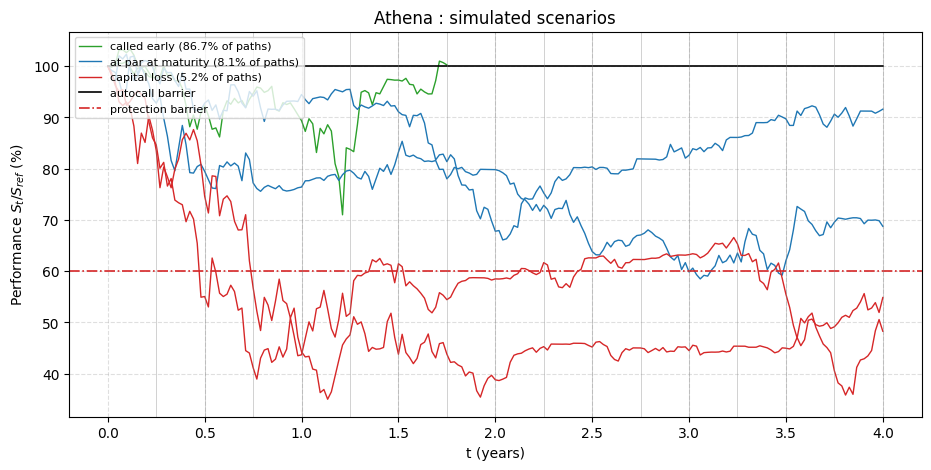
Base case: 4 years, quarterly observations, snowball coupon of 6% a year, autocall at 100%, European protection at 60%. Its price is 97.80 ± 0.11 (95%) for a nominal of 100, so the fair coupon is 10.54%.

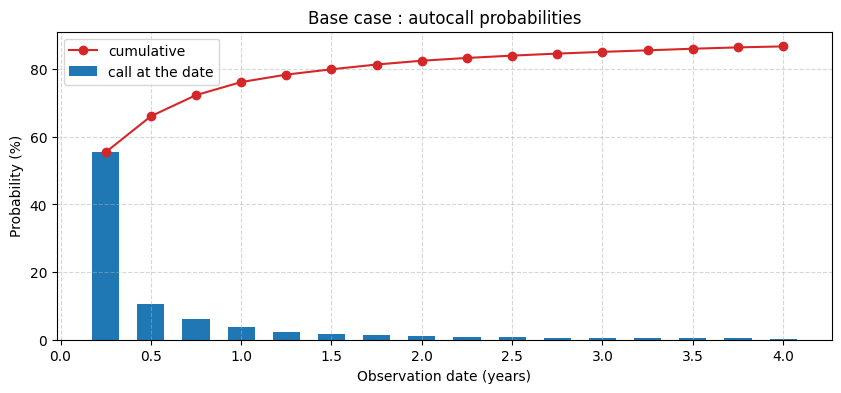
55.4% Probability of a call at the first quarter; 86.7% are called before maturity.
1.03 years Expected life of a 4-year note (median: three months).
5.22% Probability of a capital loss, about 58% of the nominal when it happens (expected loss 3.05%).
3.01% Coupon actually received on average, far below \(4\times6\%\).
Probability of a call at each quarterly observation date and cumulated probability
Probability of a call at each observation date, and cumulated.
Simulated paths of the performance grouped by outcome with the autocall and protection barriers
Simulated paths grouped by outcome: called early, redeemed at par, or knocked in at maturity.

What moves the fair coupon.

Each parameter is moved alone, on the same paths (common random numbers). A change that lowers the value of the note for a given coupon must be paid back by a higher fair coupon.

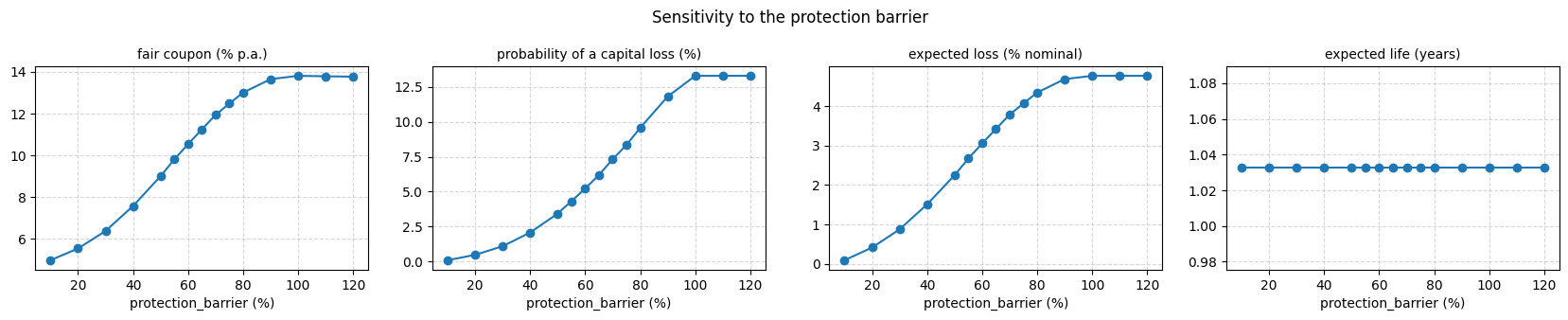
Protection barrier. A higher barrier exposes the investor more often to the loss: the fair coupon goes from 9.00% at 50% to 11.94% at 70% and 13.00% at 80%. The call probabilities do not move, since the protection only matters at maturity.

Fair coupon, loss probability, expected loss and expected life against the protection barrier
Sensitivity to the protection barrier.

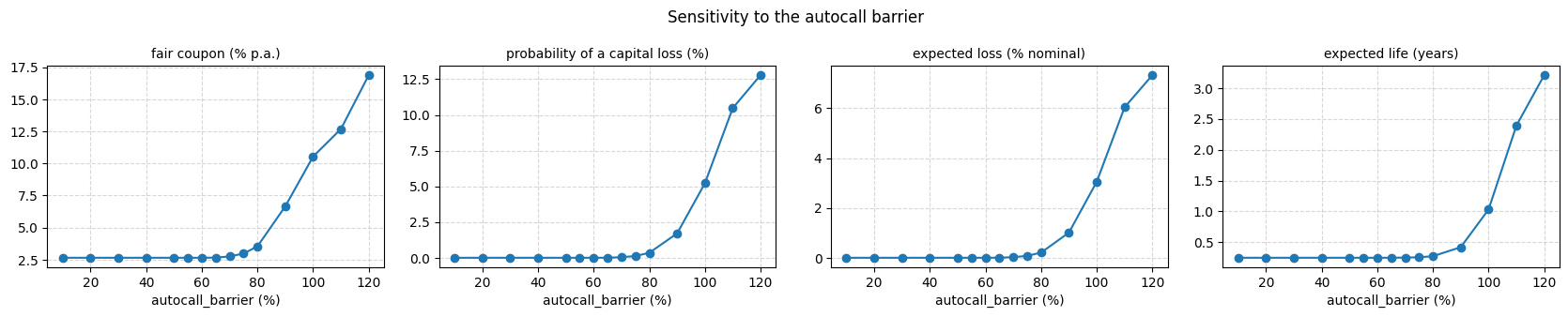
Autocall barrier. A higher barrier makes the call less likely, the note lives longer (0.42 years at 90%, 2.39 at 110%) and the fair coupon rises steeply, from 6.66% to 12.69%. Below 60%, the note is called at the first date on every path: it is a three-month deposit, and the fair coupon is the three-month rate, 2.65%.

Fair coupon, loss probability, expected loss and expected life against the autocall barrier
Sensitivity to the autocall barrier.

Market. The note is now fixed (coupon 6%) and the market moves:

Scenario Price at 6% Fair coupon P(call \(t_1\)) P(loss) E[life] (y)
Base97.8010.54%55.4%5.22%1.03
Volatility −3 pts98.708.69%56.8%3.79%1.00
Volatility +3 pts96.8212.56%54.2%6.70%1.07
Dividend yield −1%98.359.38%57.0%4.51%0.96
Dividend yield +1%97.1312.02%53.9%6.07%1.11
Rates −1%98.099.95%53.9%6.07%1.11
Rates +1%97.5111.16%57.0%4.51%0.96
Issuer spread 100bp96.8912.48%55.4%5.22%1.03
Issuer spread 200bp96.0314.40%55.4%5.22%1.03
Maturity 1 year99.577.56%55.4%1.67%0.52
Maturity 5 years97.5610.60%55.4%5.62%1.16
Correlation \(\rho=-0.9\)97.9910.51%60.0%4.82%0.91
Correlation \(\rho=0\)97.6510.33%46.9%5.60%1.28

Base Athena under moved market parameters, nominal 100.

Volatility One vol point costs 0.33 on 100 and adds 0.65 point of coupon: the investor is short the put.
Dividends A higher yield lowers every forward: later calls, more knock-ins. One point of yield is worth 1.3 points of coupon, twice a vol point.
Rates & spread Higher rates make the put cheaper but raise the issuer's funding benefit \(1-\mathbb E[D(\tau)]\); the second effect wins, and coupons rise with rates. Each 50bp of issuer spread adds about 0.96 point of coupon.
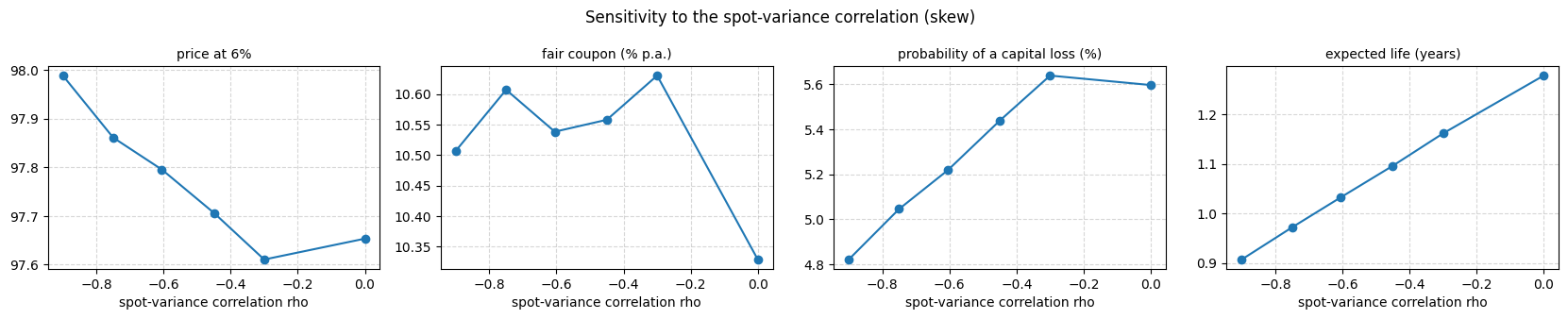
Skew A steeper skew makes the put dearer but raises the median of the index, so the note is called earlier. For the Athena, the two effects offset: the fair coupon stays between 10.3% and 10.6%.
Price, fair coupon, loss probability and expected life against the Heston spot-variance correlation
Sensitivity to the spot-variance correlation \(\rho\), the driver of the skew.

What the issuer has to hedge.

The issuer is short the note: long the put sold by the investor, short the autocall. Hedge of the base case at inception, for a nominal of 1 million euros:

Risk (nominal 100) Value Issuer hedge (nominal 1M)
Delta0.00470 / ptBuy 47 index units (≈ 378,000 EUR of futures)
Vega−0.315 / vol ptSell 163 four-year puts struck at 60%
Dividend−0.689 / +1%Sell dividend futures
Rho−0.210 / +1%Receive fixed on a swap

The note behaves like 37.8% of its nominal invested in the index, but this exposure is not stable: when the index falls toward the protection barrier, the delta triples (0.0146 per point at 4825), and the issuer must buy index in a falling market. Close to maturity, the loss jump at the barrier creates large delta and gamma (pin risk), the reason why issuers like airbags and buffers.

Price, delta, gamma and vega of the base Athena as a function of the spot
Price, delta, gamma and vega against the spot. The issuer holds the opposite.

Nineteen Athenas, sorted by coupon.

Variant Price at 6% Fair coupon P(maturity) P(loss) E[loss] E[life] (y) E[coupon]
Guaranteed 100%100.574.83%13.29%0.00%0.00%1.033.01%
Guaranteed 90%100.095.81%13.29%5.22%0.52%1.033.01%
Airbag99.117.83%13.29%5.22%1.61%1.033.01%
Step-down 1%98.818.24%8.12%4.44%2.62%0.873.29%
Duo 90% / 50%99.378.86%3.13%1.70%1.01%0.421.33%
Non-call 1 year97.158.94%22.06%8.42%4.92%1.896.02%
Look back min 1m98.759.08%9.03%3.57%2.09%0.782.51%
Annual observation96.619.41%25.70%9.06%5.27%2.066.22%
Semi-annual observation97.229.93%18.61%6.97%4.08%1.484.39%
Base case97.8010.54%13.29%5.22%3.05%1.033.01%
Range accrual 80–120%97.6810.99%13.29%5.22%3.05%1.032.88%
Monthly observation98.6211.11%7.77%3.13%1.83%0.591.66%
Buffer 10%97.3711.42%13.29%11.81%3.50%1.033.01%
Daily observation99.6511.74%1.80%0.78%0.46%0.130.38%
American protection (daily)96.9212.31%13.23%8.98%4.06%1.033.01%
American protection96.8312.53%13.29%9.22%4.11%1.033.01%
Autocall 110%94.3312.69%37.56%10.48%6.04%2.395.33%
Protection 80%96.6013.00%13.29%9.57%4.34%1.033.01%
Fixed coupon96.1623.94%13.29%5.22%3.05%1.031.30%

Each variant changes one feature of the base case. Heston, 50,000 paths, coupon 6% a year, nominal 100.

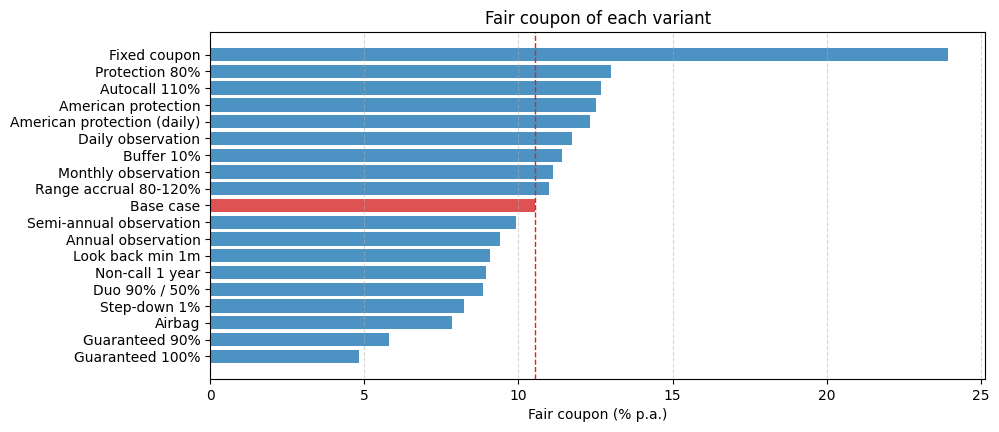
Fair coupon of each Athena variant, base case highlighted
Fair coupon of each variant (base case in red).
Protection The guarantee and the airbag reduce the loss without changing the scenarios; the American protection (+2 points), a higher barrier and the buffer make the loss more likely.
Call Step-down, duo and look back make the call easier and lower the coupon; a higher autocall barrier does the opposite.
Timing With a snowball, the coupon is earned over the life of the note: anything that shortens it (more frequent observations) raises the rate needed, a non-call period lowers it. A fixed coupon, paid once, needs 23.94% a year.

Long the index, short vol, short dividends.

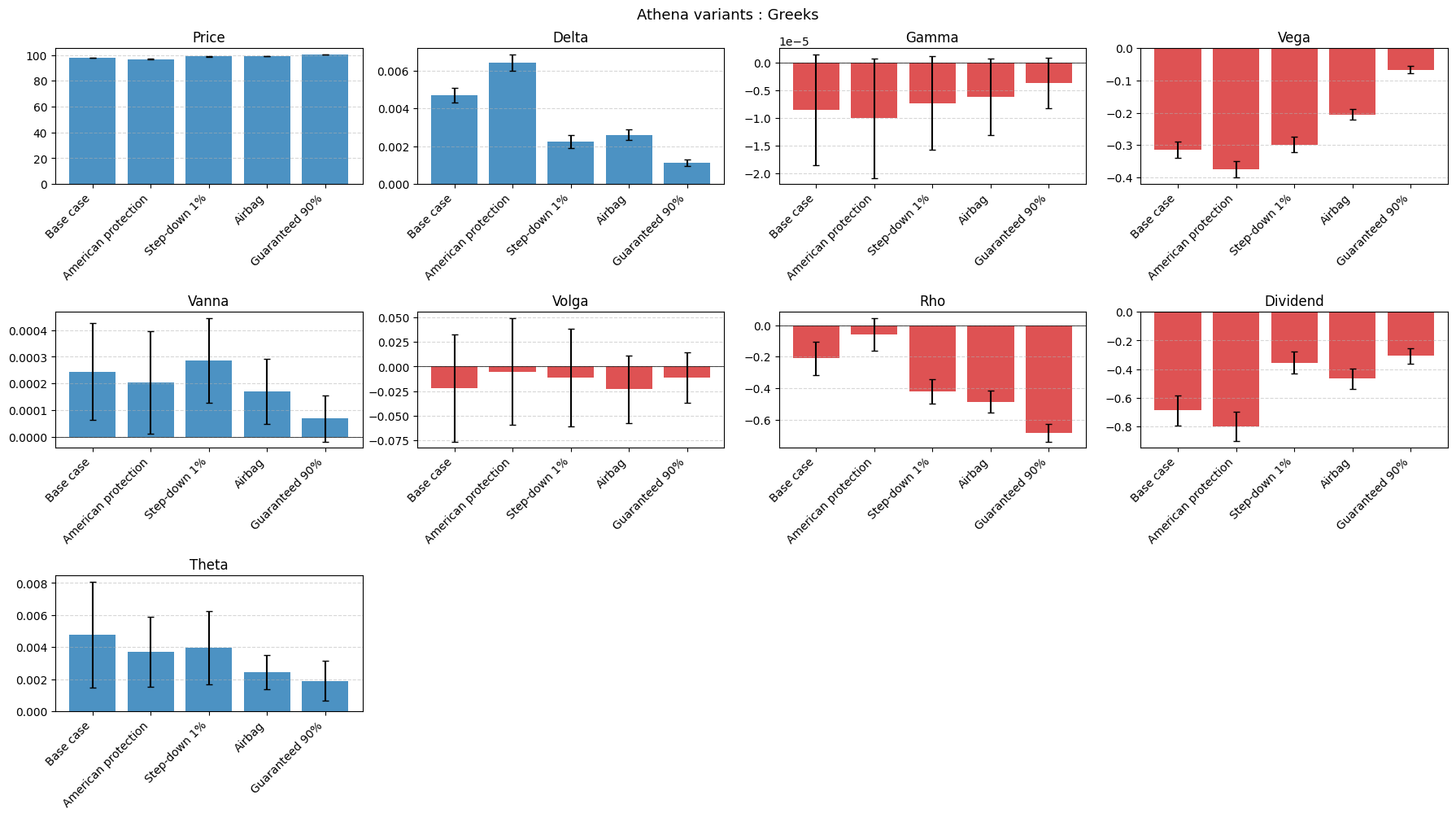
Athena Price Delta (1%) Vega Vanna (×10⁴) Rho Dividend Theta
Base case97.800.378−0.3152.45−0.210−0.6890.0048
American protection96.830.515−0.3752.04−0.058−0.8010.0037
Step-down 1%98.810.181−0.2992.86−0.421−0.3540.0040
Airbag99.110.209−0.2051.70−0.486−0.4650.0024
Guaranteed 90%100.090.091−0.0660.69−0.683−0.3070.0019

Nominal 100, coupon 6%. Vega per vol point, Rho and Dividend per +1%, Theta per day. Gamma and Volga are not significant at 50,000 paths.

A 1% rise of the index is worth 0.38 on 100, one vol point costs 0.32 and one point of dividend yield 0.69, twice the vega. The American protection raises delta and vega and almost cancels the rho; the step-down, the airbag and the guarantee reduce every risk except the rate risk, the guaranteed note behaving like a zero-coupon bond. In Heston terms, the note is mostly sensitive to the initial variance \(v_0\) (\(-61.7\)), since most notes are called within a year.

Greeks of five Athena variants with 95% confidence intervals
Greeks of the Athena variants with 95% confidence intervals.

What is not modelled.

Underlying Single index; most notes sold are worst-of on two to four underlyings and need a correlation model.
Model Pure Heston with constant parameters; the market standard is local stochastic volatility, which fixes the forward skew differently.
Credit Fair coupon at par, no margin; the issuer spread is only a parallel discounting spread, without default.
Numerics Euler full truncation with the Feller condition violated; Gamma and Volga not significant because the payoff jumps at the barriers.
An Athena is sold on its coupon but priced on its tails: a 5% chance of a capital loss decides the 10.54% coupon, and every feature of the note is a way of moving it.

Paper.

Full paper

Athena Autocallable Notes on the CAC40 under a Calibrated Heston Model: Fair Coupons, Scenarios and Greeks.

athena_autocall.pdf
Open PDF ↗

Companion project: the Phoenix autocall, priced on the same paths.