A pricer for the Phoenix, the autocallable note that pays
a conditional coupon at every observation date where the
index is above a coupon barrier, on the CAC40 under the
calibrated Heston model. The base 4-year quarterly note
with memory and a 70% coupon barrier is worth a fair
coupon of 6.04% a year, against 10.54% for the Athena with
the same dates. Contrary to the Athena, everything that
shortens the life of a Phoenix raises its coupon, and its
investor is short skew.
MethodMonte Carlo, 50,000 antithetic paths · Brownian bridge · put control variate
OutputsFair coupon, scenario statistics, market sensitivities, Greeks and hedge
01 / Introduction
A stream of conditional coupons.
Like every autocall, the Phoenix is redeemed early as
soon as the index is back above its initial level on
an observation date, and its coupon is financed by a
down-and-in put sold by the investor. What changes is
the coupon: it is paid at each date where the index
is above a coupon barrier, lower than the
autocall barrier, usually with a memory of
the coupons missed.
The base Phoenix has the same dates, autocall and
protection as the base note of the
Athena project and is
priced on the same paths, so the two products can be
compared exactly. Both use the Heston model
calibrated in the Heston
project and the Monte Carlo engine of the
barrier option
pricer.
02 / Product
Coupon barrier and memory.
With \(P_k=S_{t_k}/S_{\mathrm{ref}}\), the Phoenix
pays at each observation date \(t_k\le\tau\)
where \(m_k\) is the number of periods since the last
payment with memory, and 1 without. When called, the
note is redeemed at \(N\). If never called, it pays
the last coupon (if \(P_T\ge B^{\mathrm{cpn}}\)) and
the same redemption as the Athena:
\(B^{\mathrm{cpn}}=0\)Unconditional coupon: a callable fixed-rate bond with a short put.
\(B^{\mathrm{cpn}}=B^{\mathrm{call}}\)With memory, coupons are only paid at the call, all together: exactly a snowball Athena.
FeaturesSame class parameters as the Athena: frequency, step-down, non-call, European or American protection, airbag, buffer, guarantee, range accrual, duo and look back.
03 / Valuation
Same put, more valuable coupon.
The price is again affine in the coupon, and on a
nominal of 1 it decomposes as
The zero-coupon part \(A=\mathbb E[D(\tau)]-\mathrm{PDI}^{ac}\)
does not depend on the coupon condition:
for the same dates and barriers, the Phoenix
and the Athena have the same \(A\) and only
differ through the value \(B\) of a unit coupon.
Hence
On the base case, 6.04% against 10.54%: a unit
coupon is worth 1.75 times more in the Phoenix,
because it is also paid when the index stays between
70% and 100%. Each coupon is a digital call struck at
\(B_c\), knocked out by an earlier call, so the strip
adds a second exposure to the skew.
04 / Engine
Same engine, three checks.
The pricing setup is the one of the
Athena: Heston calibrated
on the CAC40, 50,000 antithetic paths on a weekly
grid, Brownian bridge for the American protection,
European put as control variate. At each date the
coupon is paid first (with the missed coupons if the
note has a memory), then the call is checked.
Test
Reference
Monte Carlo
Std error
Error / std error
Never called, unconditional 6% coupon (flat)
104.240
104.252
0.014
0.79
Called for sure at \(t_1=0.25\) (flat)
100.742
100.742
0
exact
Memory, \(B^{\mathrm{cpn}}=B^{\mathrm{call}}\) vs snowball Athena (CAC40)
98.767
98.767
0.059
identical
Flat Black-Scholes market: \(S_0=100\),
\(r=3\%\), \(q=1\%\), \(\sigma=20\%\), \(T=2\),
protection at 60. The last test runs on the
CAC40 paths.
05 / Base case
Same scenarios, more coupons.
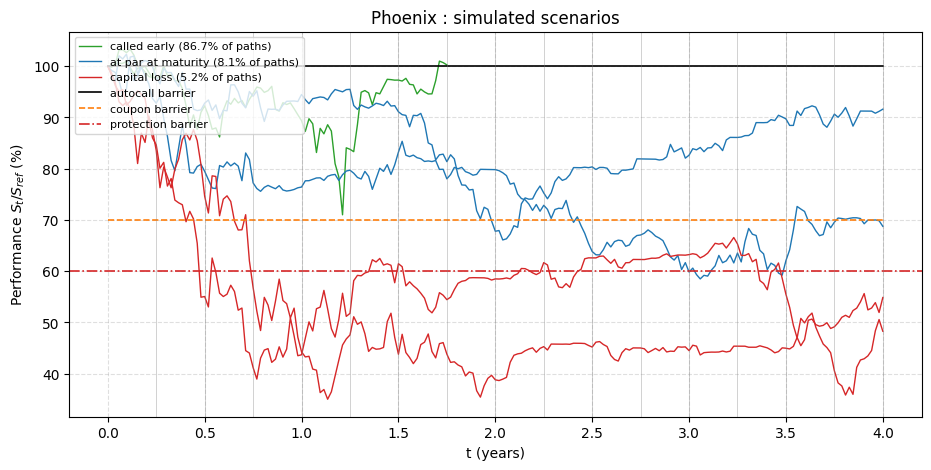
Base case: 4 years, quarterly
observations, coupon of 6% a year (1.5% a quarter)
with memory and a coupon barrier at 70%, autocall at
100%, European protection at 60%. Its price is
99.96 ± 0.10 (95%): the fair coupon is
6.04%.
55.4%Probability of a call at the first quarter, exactly as for the Athena: the coupon does not change the call rule.
3.28Coupons paid on average, 5.23% of the nominal against 3.01% for the Athena.
5.22%Probability of a capital loss (expected loss 3.05%), the same put as the Athena.
1.03 yearsExpected life of a 4-year note.
Simulated paths grouped by outcome, with the
coupon, autocall and protection barriers.
06 / Sensitivities
Where the Phoenix and the Athena part ways.
Coupon barrier. A higher barrier
pays fewer coupons and raises the fair coupon, slowly
up to 70% and steeply above: 5.43% at 50%, 6.67% at
80%, 7.87% at 90%, and 10.54% at 100%, where the
Phoenix becomes the snowball Athena. The memory is
worth 0.37 point of coupon at 70% and 2.41 points at
90%.
Sensitivity to the coupon barrier.
Autocall barrier. A higher barrier
keeps the note alive longer: more paths are exposed
to the put, but many more coupons are paid (8.04 at
110% against 3.28 at 100%). The fair coupon first
rises to 6.10% at 95%, then falls (5.31% at 110%,
4.96% at 120%), while the Athena coupon rises from
6.66% to 12.69% over the same range.
Sensitivity to the autocall barrier.
Protection barrier. Same loss
statistics as the Athena, but a flatter coupon: 5.16%
at 50%, 6.85% at 70%, 7.45% at 80%, since each point
of coupon is worth 1.75 times more.
Market. The note is fixed (coupon
6%) and the market moves:
Scenario
Price at 6%
Fair coupon
P(call \(t_1\))
P(loss)
E[coupons]
Base
99.96
6.04%
55.4%
5.22%
3.28
Volatility −3 pts
100.90
4.94%
56.8%
3.79%
3.37
Volatility +3 pts
98.95
7.24%
54.2%
6.70%
3.19
Dividend yield −1%
100.22
5.73%
57.0%
4.51%
3.10
Dividend yield +1%
99.65
6.40%
53.9%
6.07%
3.48
Rates −1%
100.64
5.30%
53.9%
6.07%
3.48
Rates +1%
99.35
6.82%
57.0%
4.51%
3.10
Issuer spread 100bp
99.04
7.15%
55.4%
5.22%
3.28
Issuer spread 200bp
98.15
8.24%
55.4%
5.22%
3.28
Maturity 1 year
100.88
4.21%
55.4%
1.67%
1.98
Maturity 5 years
99.87
6.15%
55.4%
5.62%
3.50
Correlation \(\rho=-0.9\)
99.71
6.40%
60.0%
4.82%
2.82
Correlation \(\rho=0\)
100.89
5.18%
46.9%
5.60%
4.24
Base Phoenix under moved market parameters,
nominal 100.
VolatilityOne vol point costs 0.33 on 100, as for the Athena, and adds 0.40 point of coupon.
DividendsA lower forward makes the put dearer but delays the call and adds coupons: the fair coupon only moves from 5.73% to 6.40%, against 9.38% to 12.02% for the Athena.
RatesAn earlier call also removes coupons: 0.76 point of coupon per point of rate, more than the Athena (0.61).
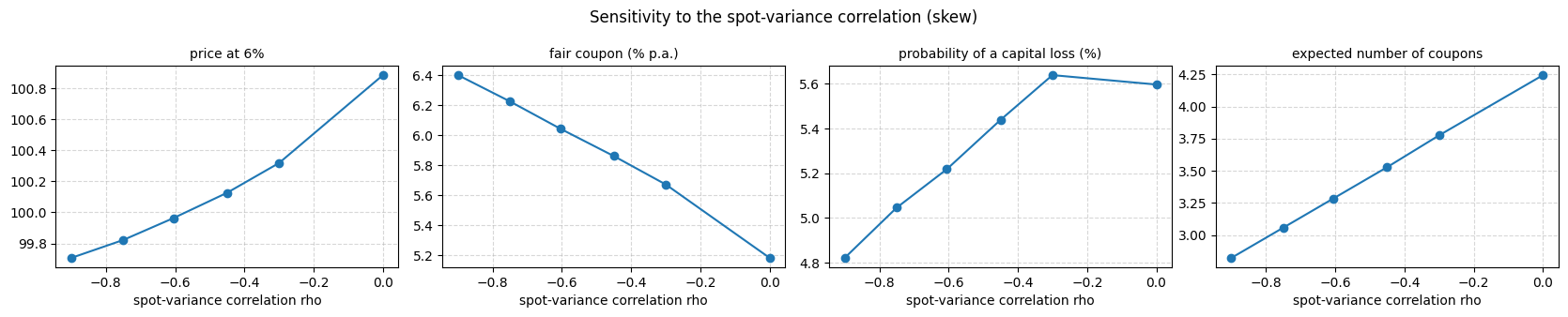
SkewA steeper skew makes the put dearer and the call earlier, which now removes coupons: both effects raise the coupon, from 5.18% at \(\rho=0\) to 6.40% at \(\rho=-0.9\). The Phoenix investor is short skew; the Athena investor is almost neutral.
Sensitivity to the spot-variance correlation
\(\rho\), the driver of the skew.
07 / Hedging
Delta-neutral, until the index falls.
Risk (nominal 100)
Value
Issuer hedge (nominal 1M)
Delta
0.00059 / pt
Buy 5.9 index units (≈ 47,000 EUR of futures)
Vega
−0.335 / vol pt
Sell 173 four-year puts struck at 60%
Dividend
−0.325 / +1%
Sell dividend futures
Rho
−0.599 / +1%
Receive fixed on a swap
At inception the Phoenix is equivalent to only 4.7%
of its nominal in the index (37.8% for the Athena): a
rise reduces the short put but also calls the note
and stops a coupon stream worth more than its cost.
When the index falls, the note turns into a short
put and its delta rises to 0.0097 at 75% and 0.0213
at the barrier: the issuer must buy index from
almost nothing in a falling market. The vega is most
negative just above the coupon barrier, and the rate
risk is three times that of the Athena.
Price, delta, gamma and vega against the spot.
The issuer holds the opposite.
08 / Features
Twenty-one Phoenix notes, sorted by coupon.
Variant
Price at 6%
Fair coupon
P(maturity)
P(loss)
E[loss]
E[life] (y)
E[coupons]
Guaranteed 100%
102.74
2.77%
13.29%
0.00%
0.00%
1.03
3.28
Guaranteed 90%
102.26
3.33%
13.29%
5.22%
0.52%
1.03
3.28
Airbag
101.28
4.49%
13.29%
5.22%
1.61%
1.03
3.28
Unconditional coupon
100.87
5.13%
13.29%
5.22%
3.05%
1.03
4.13
Autocall 110%
101.40
5.31%
37.56%
10.48%
6.04%
2.39
8.04
Non-call 1 year
100.86
5.46%
22.06%
8.42%
4.92%
1.89
6.21
Annual observation
100.62
5.63%
25.70%
9.06%
5.27%
2.06
1.67
Look back min 1m
100.20
5.69%
9.03%
3.57%
2.09%
0.78
2.53
Semi-annual observation
100.22
5.82%
18.61%
6.97%
4.08%
1.48
2.38
Base case
99.96
6.04%
13.29%
5.22%
3.05%
1.03
3.28
Step-down 1%
99.89
6.16%
8.12%
4.44%
2.62%
0.87
2.73
Monthly observation
99.91
6.19%
7.77%
3.13%
1.83%
0.59
5.53
Duo 90% / 50%
99.89
6.35%
3.13%
1.70%
1.01%
0.42
1.37
No memory
99.67
6.41%
13.29%
5.22%
3.05%
1.03
3.28
Daily observation
99.94
6.52%
1.80%
0.78%
0.46%
0.13
25.97
Buffer 10%
99.54
6.55%
13.29%
11.81%
3.50%
1.03
3.28
American protection (daily)
99.07
7.11%
13.23%
8.98%
4.06%
1.03
3.28
American protection
99.00
7.18%
13.29%
9.22%
4.11%
1.03
3.28
Range accrual 80–120%
99.02
7.41%
13.29%
5.22%
3.05%
1.03
3.28
Protection 80%
98.77
7.45%
13.29%
9.57%
4.34%
1.03
3.28
Coupon barrier 90%
98.78
7.87%
13.29%
5.22%
3.05%
1.03
2.03
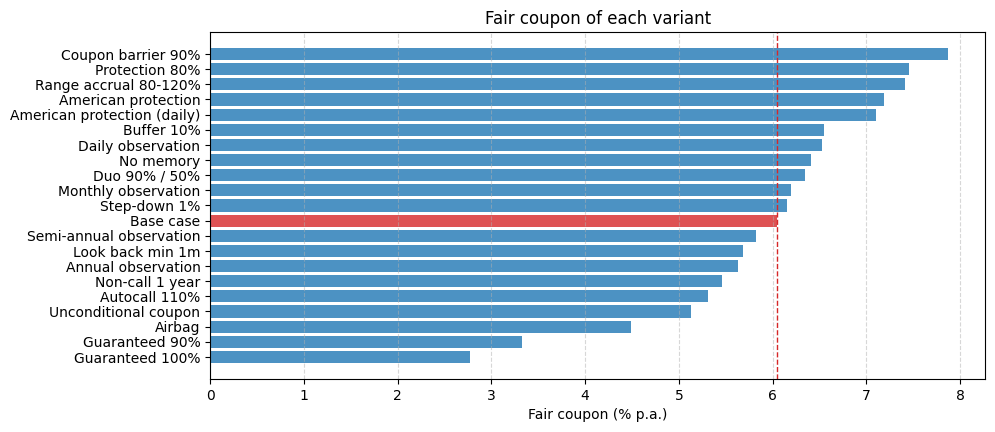
Each variant changes one feature of the base
case. Heston, 50,000 paths, coupon 6% a year,
nominal 100.
Fair coupon of each variant (base case in red).
Protection
As for the Athena: guarantee and airbag
reduce the loss, the American protection
(+1.14 points, against +1.99 for the Athena),
a higher barrier and the buffer make it more
likely.
Coupon
Coupon barrier, memory and range accrual act
directly on the coupons. The range accrual
costs far more than on the Athena (7.41%
against 6.04%), since every week outside the
range costs a coupon.
Life
Everything that shortens the life stops the
coupon stream: step-down, duo and more
frequent observations raise the fair coupon,
a higher autocall barrier or a non-call
period lower it. The opposite of the Athena.
09 / Greeks
Short vol, short skew, long duration.
Phoenix
Price
Delta (1%)
Vega
Vanna (×10⁴)
Rho
Dividend
Theta
Base case
99.96
0.047
−0.335
6.13
−0.599
−0.325
0.0050
American protection
99.00
0.184
−0.394
5.72
−0.448
−0.437
0.0039
Step-down 1%
99.89
0.037
−0.270
3.37
−0.579
−0.198
0.0032
Airbag
101.28
−0.121
−0.224
5.38
−0.875
−0.101
0.0026
Guaranteed 90%
102.26
−0.239
−0.086
4.37
−1.073
0.057
0.0021
No memory
99.67
0.085
−0.365
6.27
−0.560
−0.357
0.0053
Nominal 100, coupon 6%. Vega per vol point, Rho
and Dividend per +1%, Theta per day. Gamma and
Volga are not significant at 50,000 paths.
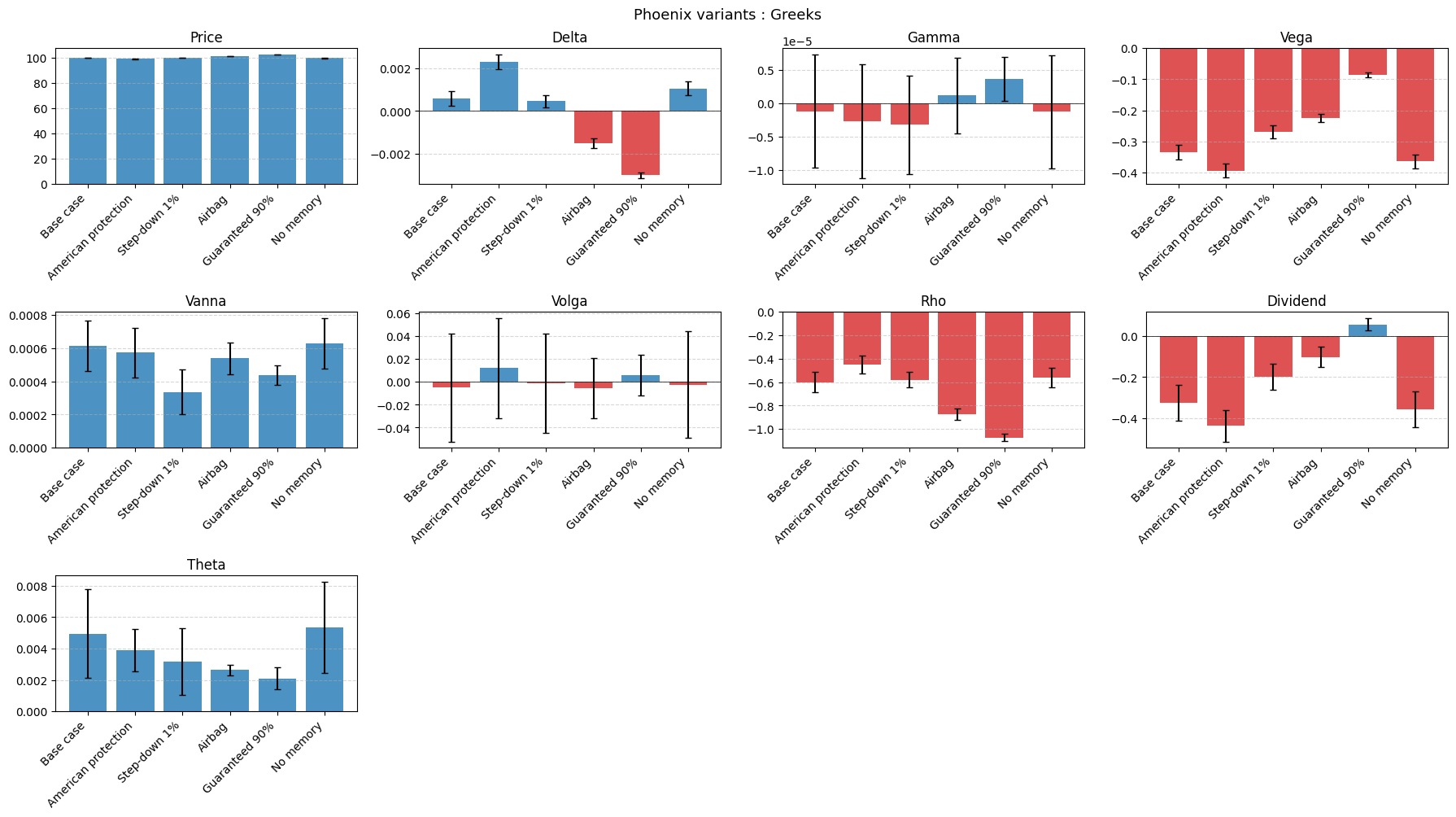
When the put is reduced (airbag) or mostly removed
(guarantee), the loss of coupons from an earlier call
wins and the delta turns negative; the guaranteed
note even gains from higher dividends, which delay
the call. In Heston terms, the Phoenix is as
sensitive to the long-term variance \(\theta\)
(\(-44.9\)) as to \(v_0\) (\(-40.4\)): its coupon
stream lasts longer than the single coupon of the
Athena.
Greeks of the Phoenix variants with 95%
confidence intervals.
10 / Phoenix vs Athena
Same put, different coupon.
Athena (snowball)
Phoenix (memory, 70%)
Fair coupon
10.54%
6.04%
P(call at first date) / P(loss)
55.4% / 5.22%
55.4% / 5.22%
Expected coupon paid at 6%
3.01%
5.23%
Delta (per 1%)
0.378
0.047
Vega / Rho / Dividend
−0.32 / −0.21 / −0.69
−0.34 / −0.60 / −0.33
Autocall 110%
12.69%
5.31%
Step-down 1%
8.24%
6.16%
Non-call 1 year
8.94%
5.46%
Correlation \(\rho=-0.9\) / \(0\)
10.51% / 10.33%
6.40% / 5.18%
Base cases on the same paths: 4 years,
quarterly, autocall 100%, European protection
60%.
The Athena concentrates its coupon in the scenarios
where the index is up: higher coupon, eight times
the delta, value tied to the timing of the call. The
Phoenix pays as long as the index stays above 70%: a
stream of conditional coupons, more stable for the
investor, short skew and three times more exposed to
the rates. With a coupon barrier equal to the
autocall barrier and memory, the two coincide.
11 / Resources
Paper.
Full paper
Phoenix Autocallable Notes on the CAC40 under
a Calibrated Heston Model: Fair Coupons,
Scenarios and Greeks.